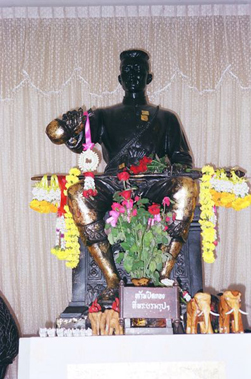
This monument is locate4d in the vicinity of Tambon Don Chedi, Amphoe Si Prachan, 31 kilometers from the township area. The pagoda was constructed by the royal command of King Naresuan the Great to command his victory against The Crown Prince of Burma (King Mahauparacha) in single hand elephant back combat. Found in 1913 in ruined condition, only the base part can be seen. It was renovated having a new pagoda covered the original one in the year 1952 by the government. A cast status of King Naresuan the Great mounting the elephant's neck was placed in front of the pagoda. An annual fair celebrating the monument for seven days and seven nights commences on the 25th of January which is regarded as Royal Thai Armed Forces Day. The celebrations include historic shows, folk entertainment and shops selling all kinds of merchandise and service.

Showing posts with label Naresuan. Show all posts
Showing posts with label Naresuan. Show all posts
Saturday, April 21, 2007
Don Chedi Monument in Suphanburi Province
This monument is locate4d in the vicinity of Tambon Don Chedi, Amphoe Si Prachan, 31 kilometers from the township area. The pagoda was constructed by the royal command of King Naresuan the Great to command his victory against The Crown Prince of Burma (King Mahauparacha) in single hand elephant back combat. Found in 1913 in ruined condition, only the base part can be seen. It was renovated having a new pagoda covered the original one in the year 1952 by the government. A cast status of King Naresuan the Great mounting the elephant's neck was placed in front of the pagoda. An annual fair celebrating the monument for seven days and seven nights commences on the 25th of January which is regarded as Royal Thai Armed Forces Day. The celebrations include historic shows, folk entertainment and shops selling all kinds of merchandise and service.


Major Works of King Naresuan the Great
B.E.2098
Pra Naresuan was born in Phitsanulok.
B.E.2107
Phitsanulok was under the force of Burma. King Burengnong directed key person to be hostages,one of them was Pra Naresuan, who was 9 years old, to live in Hongsavadee.
B.E.2112
On August, Burma was victorious on Ayuddhaya. King Burengnong appointed Pra Mahathammaracha to be king.
B.E.2114
King Mahathammaracha promoted Pra Naresuan to the position of Crown Prince governing Phitsanulok.
B.E.2124
After the decease of king Burengnong, King Angwa became recalcitrant Nantabureng, the new king of Burma, promoted Mangraikayauchava to the position of crown prince. Pra Naresuan attacked Kung Kingdom, and catch the prince of Thai Yai and send him to Hongsavadee.
B.E.2127
King Naresuan was proclaimed independent at Muang Kreang in May at 19.00 After that Ayuddhaya was in the war with King of Chaing Mai and Praya Pasim. The troops couldn’t get close to Ayuddhaya.
B.E.2128
The troops of Nantabureng went to Ayuddhaya. The troops of crown prince Mungraigayaochava had forced Kamphengphet but Pra Naresuan was fighting to gain Kamphengphet back.
B.E.2130
Hongsavadee troops surrounded Ayuddhaya for 5 month, the troops couldn’t attack with Ayuddhaya. So, King Nantabureng decided to go to Burma for retreat his troops. Then King Naresuan and his brother attacked with the navy troops, so that King Nantabureng came back urgently.
B.E.2133
King Mahathammaracha died in June. His age is 75 years old.
B.E.2133
Pra Naresuan promoted to be king when he was 35 years old and promote Pra Akathotsarot to be the crown prince. After that 4 months the Burmese crown prince took the soldiers to attack Ayuddhaya but they can’t fight with the troops of King Naresuan.
B.E.2135
The Burmese Crown Prince took soldiers to attack Ayuddhaya. King Naresuan and Pra Akatosarot led soldiers to Supanburi province to defend the capital. King Naresuan killed the Crown Prince of Burma on the elephant back. Therefore, won the war which would later be known as Yuttahatthi War.
B.E.2136
King Naresuan and Pra Akatosarot led soldiers to Kumpa and send to the King of Nakhonsrithammaraj. After that they attack Kampucha and forced it.
B.E.2137
The southern of Morn was forced by Ayuddhaya.
B.E.2138
King Naresuan and Pra Akatosarot led soldiers to Hongsavadee in December but the troops can’t get close to Hongsa. So they came back.
B.E.2142
King Naresuan and Pra Akatosarot led soldiers to Hongsavadee again but Hongsa was destroyed because King of Thong Ou attack before.
B.E.2143
After King Naresuan and Pra Akatosarot led soldiers to Thoug Ou and the troops can’t get close to there. He came back in May. In November, King Nantabureng died after that Burma spend to 3 troops.
B.E.2146
King Ang Wa promoted to be the King of Burma. In the name of The King Srihasuthammaracha.
B.E.2147
King Naresuan and Pra Akatosarot led soldiers to Chaing Mai for to attack Ang Wa but he was sick from decease.
B.E.2148
King Naresuan died at Muang Hang when he was 50 years old.
Reference : http://www.kingnaresuanmovie.com
Pra Naresuan was born in Phitsanulok.
B.E.2107
Phitsanulok was under the force of Burma. King Burengnong directed key person to be hostages,one of them was Pra Naresuan, who was 9 years old, to live in Hongsavadee.
B.E.2112
On August, Burma was victorious on Ayuddhaya. King Burengnong appointed Pra Mahathammaracha to be king.
B.E.2114
King Mahathammaracha promoted Pra Naresuan to the position of Crown Prince governing Phitsanulok.
B.E.2124
After the decease of king Burengnong, King Angwa became recalcitrant Nantabureng, the new king of Burma, promoted Mangraikayauchava to the position of crown prince. Pra Naresuan attacked Kung Kingdom, and catch the prince of Thai Yai and send him to Hongsavadee.
B.E.2127
King Naresuan was proclaimed independent at Muang Kreang in May at 19.00 After that Ayuddhaya was in the war with King of Chaing Mai and Praya Pasim. The troops couldn’t get close to Ayuddhaya.
B.E.2128
The troops of Nantabureng went to Ayuddhaya. The troops of crown prince Mungraigayaochava had forced Kamphengphet but Pra Naresuan was fighting to gain Kamphengphet back.
B.E.2130
Hongsavadee troops surrounded Ayuddhaya for 5 month, the troops couldn’t attack with Ayuddhaya. So, King Nantabureng decided to go to Burma for retreat his troops. Then King Naresuan and his brother attacked with the navy troops, so that King Nantabureng came back urgently.
B.E.2133
King Mahathammaracha died in June. His age is 75 years old.
B.E.2133
Pra Naresuan promoted to be king when he was 35 years old and promote Pra Akathotsarot to be the crown prince. After that 4 months the Burmese crown prince took the soldiers to attack Ayuddhaya but they can’t fight with the troops of King Naresuan.
B.E.2135
The Burmese Crown Prince took soldiers to attack Ayuddhaya. King Naresuan and Pra Akatosarot led soldiers to Supanburi province to defend the capital. King Naresuan killed the Crown Prince of Burma on the elephant back. Therefore, won the war which would later be known as Yuttahatthi War.
B.E.2136
King Naresuan and Pra Akatosarot led soldiers to Kumpa and send to the King of Nakhonsrithammaraj. After that they attack Kampucha and forced it.
B.E.2137
The southern of Morn was forced by Ayuddhaya.
B.E.2138
King Naresuan and Pra Akatosarot led soldiers to Hongsavadee in December but the troops can’t get close to Hongsa. So they came back.
B.E.2142
King Naresuan and Pra Akatosarot led soldiers to Hongsavadee again but Hongsa was destroyed because King of Thong Ou attack before.
B.E.2143
After King Naresuan and Pra Akatosarot led soldiers to Thoug Ou and the troops can’t get close to there. He came back in May. In November, King Nantabureng died after that Burma spend to 3 troops.
B.E.2146
King Ang Wa promoted to be the King of Burma. In the name of The King Srihasuthammaracha.
B.E.2147
King Naresuan and Pra Akatosarot led soldiers to Chaing Mai for to attack Ang Wa but he was sick from decease.
B.E.2148
King Naresuan died at Muang Hang when he was 50 years old.
Reference : http://www.kingnaresuanmovie.com
Friday, March 23, 2007
Naresuan University
 Naresuan University (NU.) is a government sponsored university in Phitsanulok, northern Thailand. It was established as a separate university on July 29,1990, which was the 400th anniversary of the beginning of the reign of Phitsanulok born King Naresuan the Great. A coutyard with a large statue of King Naresuan is located on the grounds and is worshipped by the students. The university now numbers about 20,000 students.
On January 18, 1964, the Royal Thai Ministry of Education resolved to create a branch of the College of Education ( located in Bangkok ) for teacher training in each region of the country. On January 25, 1967 the Phitsanulok campus was established as the fourth branch of the College of Education and was meant to serve mainly the northern provinces. In 1974 (the year I was born) the College of Education was upgraded to university status and was named Srinakharinwirot University, Phitsanulok campus. Originally, only the third and fourth years of university study were offered, and students were admitted by competitive examination after completing the curriculum at one of the nation's associate degree level teacher training colleges. But in 1976, the first and second years were added. Over the years majors besides education were included, and in 1990 the Phitsanulok campus became independent of Srinakarinwirot University and was designated as Naresuan University for celebration of King Naresuan the Great's 400th years anniversary of ascending to the throne.

In September 2006, Naresuan University was ranked as "Very Good" level in research among the Thai universities by Commission on Higher Education.
Naresuan University also has another campus in Phayao which operated in 1999 .
Saturday, February 10, 2007
Biography King Naresuan the Great
 Phitsanulok was the birthplace of one of the greatest heroes in Thai history - King Naresuan who was born in 1555. His father, King Mahathammaracha was a descendant of the Phra Ruang dynasty of Sukhothai, and his mother was Queen Phra Wisut Kasattri of the Suwannaphum dynasty of Ayutthaya. At the age of nine, he had been taken as hostage to Burma for 6 years. King Naresuan was a great warrior king. He liberated Ayutthaya from Burma while he was the Crown Prince. He led the soldiers into battles to defend the country against Burmese invasions many times. He is also widely known among the Thais nowadays for his heroic efforts. He led the assault of a Burmese camp by climbing the wooden stockade with the blunt side of a saber in his mouth. He had a duel on elephants with the Burmese Crown Prince and slew him. He took the offensive against Burma and also dealt with the Cambodians who made a series of raids. King Naresuan extended Ayutthaya's territory to include Lanna, Lanchang, Cambodia and some parts of Burma. He enforced strict discipline on his soldiers and the people. During his reign, Ayutthaya was a very secure and powerful state.
Apart from being a great warrior, King Naresuan also played a significant role in foreign relations and trade. Realizing the importance of foreign trade, he sent envoys to China and Spain, and cultivated friendly relations with the Europeans. Ayutthaya concluded a treaty of friendship and commerce with Spain, which was the second treaty that Siam made with a European Power. (The first European power with which Siam had a treaty was Portugal.) Under this treaty, Spaniards had the right to reside, to trade and to practice their religion in Siam. At the end of his reign, he exposed Ayutthaya to another western nation - the Dutch.
King Naresuan deserved the honor of being "the Great". He not only restored the national independence but also made Siam such a powerful country that no enemy threatened the walls of Ayutthaya again for a period of one hundred seventy three years. Three of King Naresuan's weapons and belongings have constituted a part of the Royal Regalia down to the present. The first is the musket with which he shot the Burmese leader in one of the battles to defend Ayutthaya against Burma. Second is the saber that he carried in his mouth during his assault on the Burmese camp at Ayutthaya. The last is the leather hat with a brim cut-off in the shape of a crescent moon, which he was wearing when he engaged in a duel on elephants with the Crown Prince of Burma.
For more information : http://www.kingnaresuanmovie.com/
Subscribe to:
Posts (Atom)